
Trial Onboarding
Welcome to your Ask Edgar trial. Every answer the agent gives is grounded in the structured capital-markets data below — built in-house from primary SEC filings, not scraped or summarized from the open web. This is the full data surface you're working with.
Eleven connected datasets, each extracted and structured from source filings. Ask about a single ticker for depth, or screen across the whole market on any field below.
| Data Source | What it covers | Key fields |
|---|---|---|
|
Registrations
Shelves, ATMs & Equity Lines
|
Every registration an issuer has on file — shelves, ATM programs, equity lines, primary offerings and IPOs — with how much each company can still raise. For shelves, we hold a live snapshot of the raisable amount under the SEC's baby-shelf rule (IB-6), computed from our own audited float, plus remaining ATM and equity-line capacity. | Offering amount · Remaining / raisable capacity · Baby-shelf (IB-6) raisable · ATM & equity-line capacity remaining · Underwriter fees · Legal expenses · Investor name(s) · Bank / agent · and more |
|
Offerings
Completed Financings
|
Every completed deal — follow-on offerings, IPOs, uplists, private placements, ATM and equity-line usage, and debt conversions — with the funds and banks on each. | Offering type · Gross proceeds · Shares issued · Share price (split-adjusted & unadjusted) · Discount · Warrant coverage · Underwriter fees · Investor name(s) · Bank / underwriter · and more |
|
Dilution
Warrants & Convertibles
|
Live, instrument-by-instrument terms for outstanding warrants, convertible notes, and convertible preferred — including the verbatim price-protection clauses that reset strikes. | Exercise price · Conversion price · Floor price · Price-protection clause (e.g. variable-rate) · Exercisable / expiration / maturity dates · Remaining balance · Investor name · Bank · and more |
|
Agreements
Rights & Restrictions
|
The contractual constraints that decide who can pitch the next raise, and when — right of first refusal, standstills, right of participation, and registration-rights agreements — with the dates each one lifts. | Agreement type · End / expiration date · Bank name · Investor name · and more |
|
Ownership
Beneficial Ownership & Float
|
Beneficial ownership plus accurate shares outstanding and public float — refreshed with every applicable filing, not just quarterlies, because micro-cap float moves deal terms and baby-shelf capacity constantly. | Holder & owner type · Common / preferred / options / warrants held · % of shares outstanding · Shares outstanding · Public / tradable float · and more |
|
Fundamentals
Live Cash Runway
|
A live runway view — quarterly burn with any financing activity since the last report added back, so runway reflects capital raised mid-quarter, not just the stale 10-Q number. | Cash on hand · Quarterly burn · Months of runway · Total debt · Recent financing add-backs · and more |
|
Catalysts
News & Filings
|
Summarized SEC filings (EDGAR) and press releases from the primary newswires — GlobeNewswire, PR Newswire, Business Wire and more — each classified across ~50 topic tags for screening, turning raw feeds into searchable, filterable data. | Headline · Summary · Topic tags · Form type · Date · Source link · and more |
|
Full-Text Search
Vectorized EDGAR Filings
|
The full text of SEC filings embedded as vectors, so the agent can semantically search across filings — ask a question in plain English and it retrieves the relevant passages, even when the wording differs from the filing's language. | Semantic / natural-language search · Relevant filing excerpts · Filing type · Filing date · Source link |
|
Catalysts
Clinical Trials
|
Trial-level data from ClinicalTrials.gov, keyed to ticker — turning a vague "upcoming catalyst" into a hard readout date. | Trial title · NCT id · Phase · Status · Primary completion / readout date · Sponsor · FDA-regulated flag · and more |
|
Coverage
Analyst Ratings
|
Sell-side coverage and price targets, so you can see the Street's view alongside the capital-structure picture. | Price target · Rating date · Analyst firm |
|
Contacts
Corporate Contacts
|
Direct contact info for the decision-makers at most listed companies under $1B market cap — CEO, CFO, and senior finance names with email addresses, LinkedIn profiles and bios — built from filings and enrichment providers, and kept current as executives move. Cross-referenced, so you can see which executives sit at multiple listed tickers. Coming soon: investor & fund contacts, investor relations, and legal. | Name & role (CEO / CFO / senior finance) · Email address · LinkedIn URL · LinkedIn bio · Cross-ticker executive links · and more |
The agent is powerful, but it isn't a mind reader. A little structure in how you ask turns a good answer into exactly the one you wanted.
Say exactly what you want back: the universe, the filters, the time window, and the shape of the output (a list, a chart, a drafted email). The clearer the ask, the less it has to guess.
If you already know which data should answer it, tell the agent to use it — "check the warrants & convertibles," "look at cash runway," "search the news tags." Pointing it at the right dataset gets you there faster and more accurately.
For anything you'll run more than once, don't perfect the prompt in your head. Start rough, see the output, then refine it live — "add this column," "sort by runway," "actually draft an email too."
Once you like the result, ask the agent to turn it into a skill. From then on it's a reusable workflow you can run on demand — or put on a schedule to run automatically.
A few of the workflows trial users run most — each one a prompt today, a scheduled skill tomorrow.
The moment a filing fits your criteria — a new shelf, runway under 12 months, no raise in two quarters — it qualifies the name and drafts the outreach. Your team does these by hand; it does them all.
Every issuer that fits the mandate, ranked, with the reason it's on the list — going-concern flags, near-exhausted ATMs, toxic resets now active, fresh shelves with no draws yet.
Not just the filing, but what it actually did to the cap table over time — shares outstanding across eight quarters, with each PIPE and ATM draw marked on the line.
Overnight filings across your coverage, distilled to the three names that matter — the registered direct, the new banker-CEO, the going-concern language that just appeared.
From a signal to a ready-to-send draft, logged to your CRM with a follow-up reminder set. The research, qualification, and first draft are done — you stay in control of the send.
Make the financing case, then — when financing isn't the fit — pull credible M&A candidates instead. It reasons across the data to answer the real question, not just the one you typed.
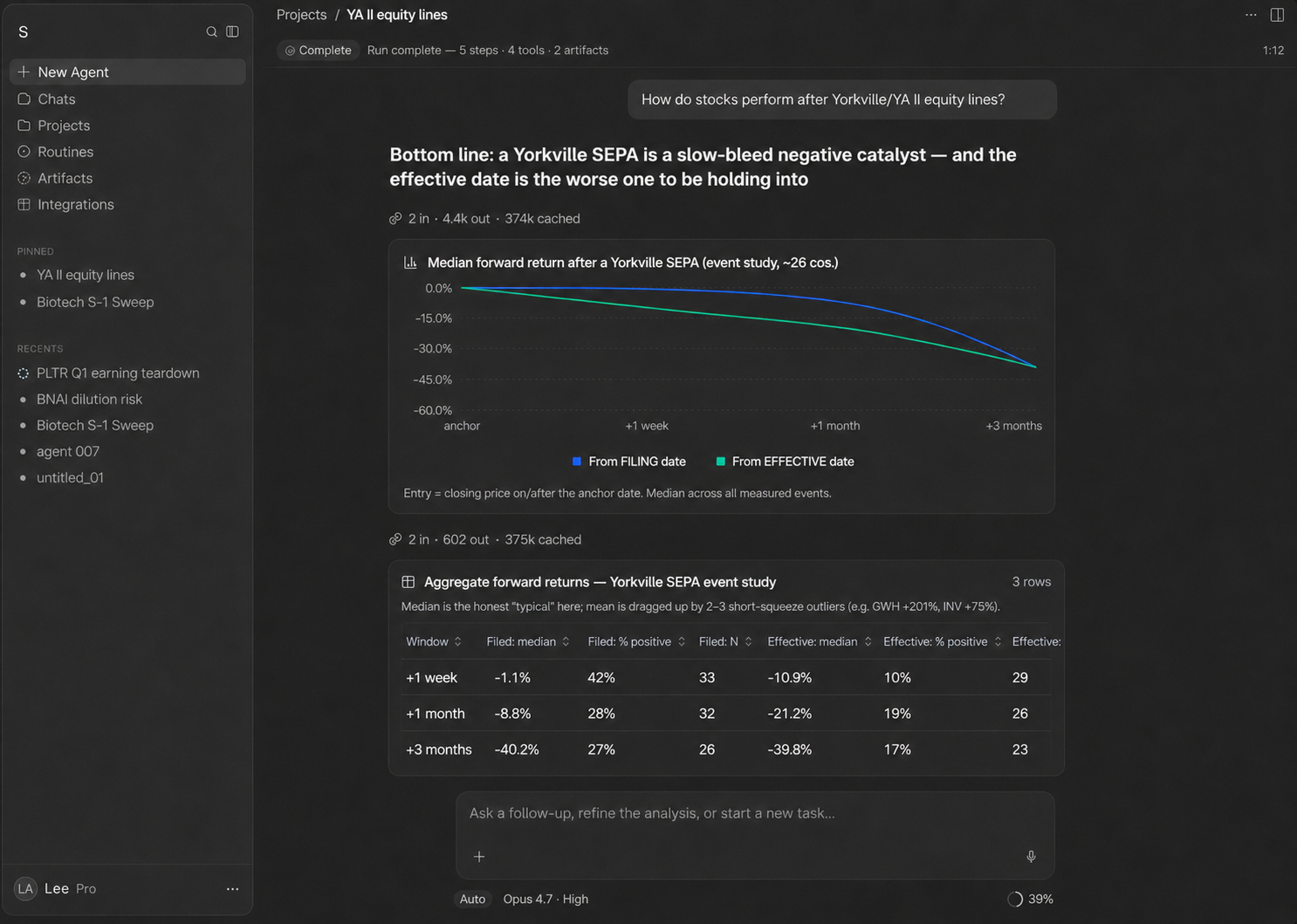
Ask how stocks behave after a Yorkville SEPA equity line — and get a sourced event study with median forward returns and the full distribution.
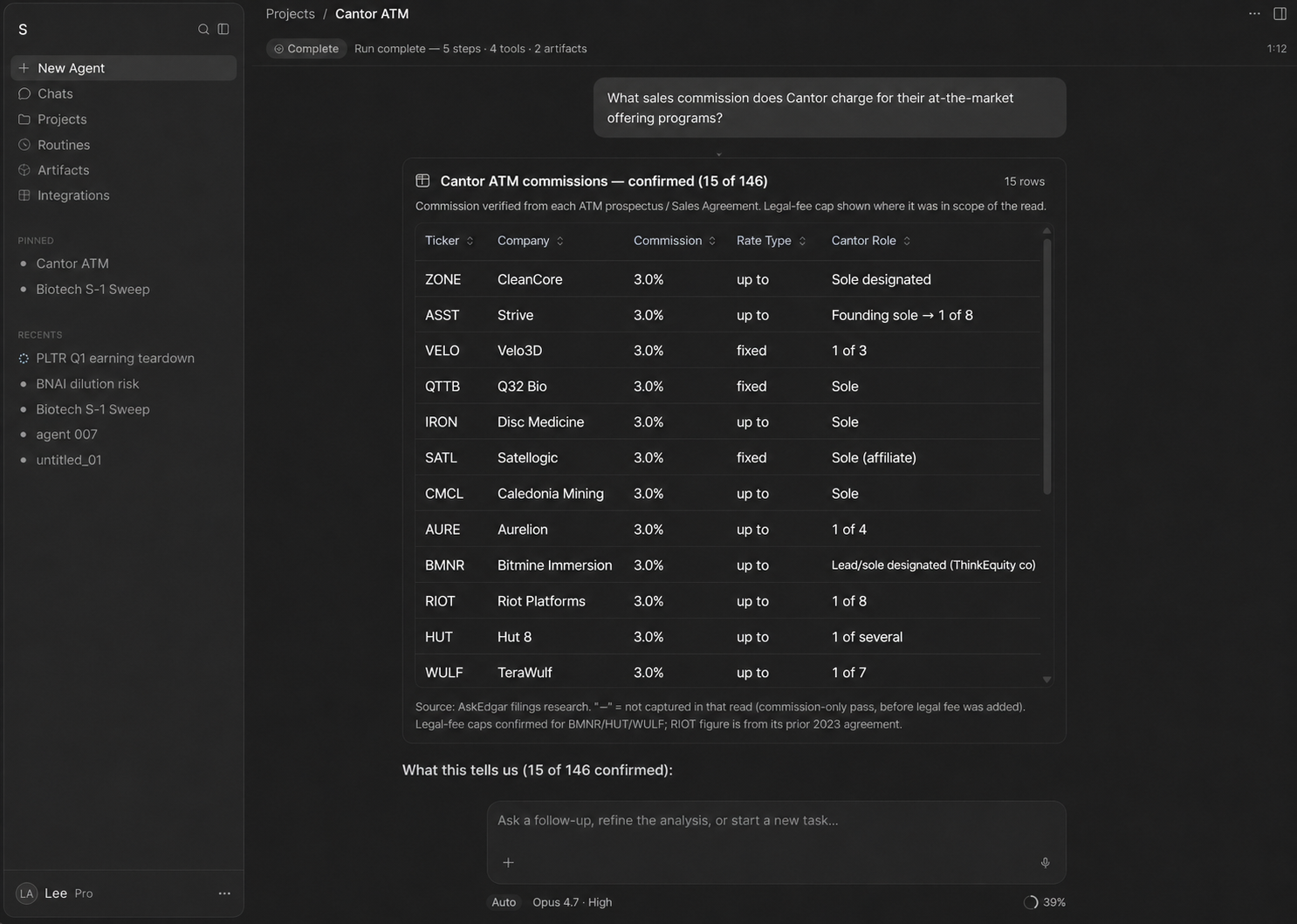
What does Cantor charge to run an ATM program? It pulls every confirmed ATM, the commission rate, and the bank's role — across companies.
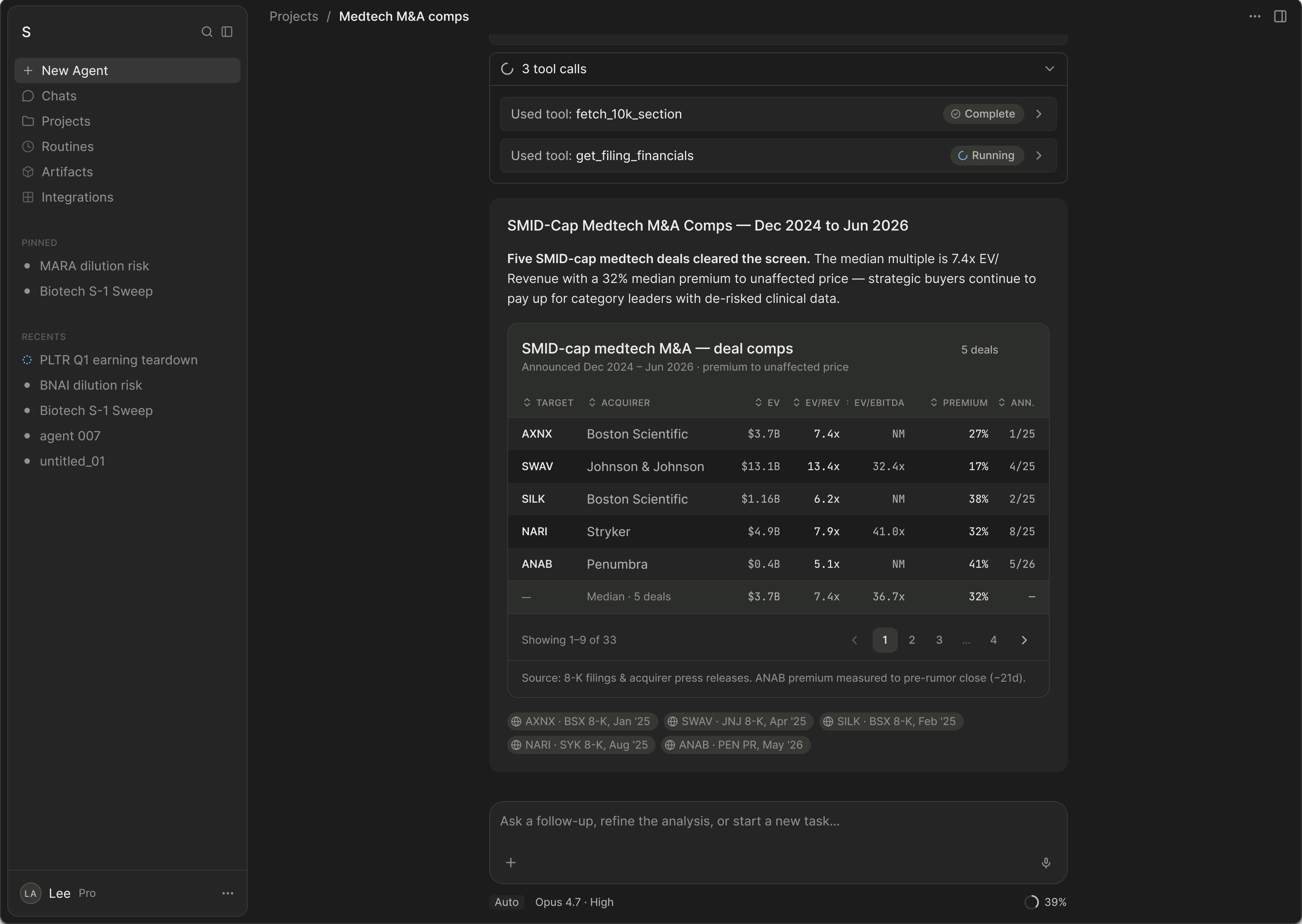
A SMID-cap medtech M&A screen with EV multiples, EV/EBITDA, and premium to unaffected — assembled straight from 8-K filings and acquirer press releases.
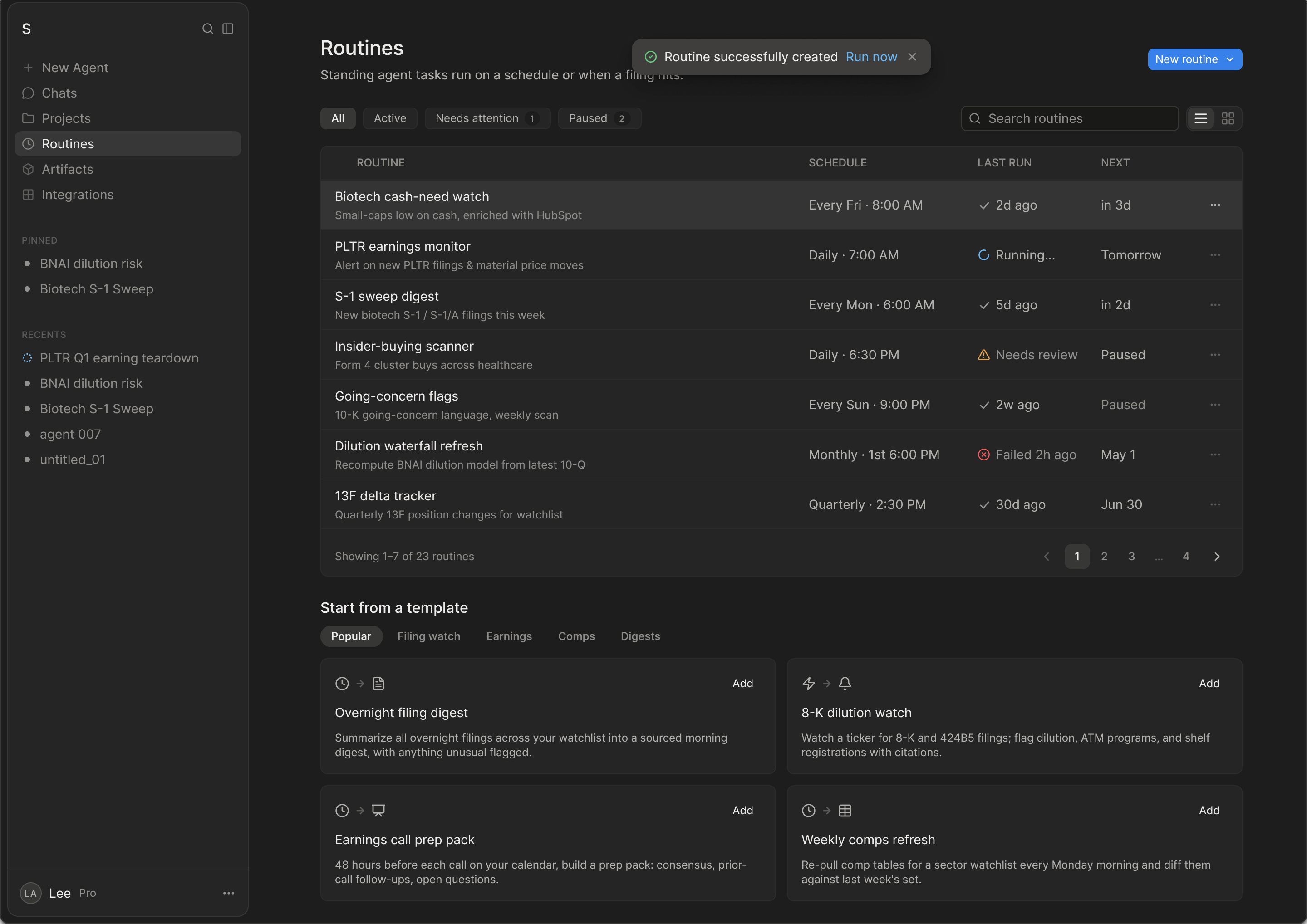
Cash-need watches, earnings monitors, S-1 sweeps, going-concern flags — scheduled to run daily, weekly, or monthly and surface only what needs attention.
Here's what you can do right now in your trial — and what's already on the way.
Spend a dollar of its time and get several back. It does the work of a desk — screening, monitoring, and drafting — for a fraction of what any of that costs today.
Full access to data and the agent that works it — below the cost of a single terminal.
Screening, monitoring, and first drafts handled around the clock — without adding to the desk.
One incremental mandate sourced through the platform covers it many times over.
Limited-time beta pricing. Locked in for early-access partners while we're in beta.
A seat at the desk: access, setup, and the agent tuned to your workflows.
The work itself, billed as it's used. Start at the beta minimum and scale the commitment as the agent takes on more of your workflow.
Most usage lands in four buckets — market screens, company deep-dives, standing routines, and collateral (decks, exports, PDFs). They're not everything the agent does, but they're where the spend goes. Think of each tier as staff working under you: you keep the judgment, the agent multiplies the output. Here's what a month looks like, drawn from live usage.
| Part-Time Analysta junior analyst under you, ~20 hrs a week≈ the usage minimum | Full-Time Analystyour own analyst, on it all day | Full Deska small team under you, around the clock | |
|---|---|---|---|
| Screens / target lists per month | 10–15 | 15–30 | 30–60 |
| Company deep-dives per month | 10–20 | 20–40 | 40–70 |
| Standing routines running in the background | 4–6 | 6–12 | 12–20 |
| Collateral decks, exports, PDFs | 2–4 | 4–8 | 8–15 |
| Est. monthly usage | $350–850 | $850–1,650 | $1,650–3,350 |
| $4,000–10,000 / yr | $10,000–20,000 / yr | $20,000–40,000 / yr | |
| That output, hired | ≈ a $40–60k part-time hire | ≈ a $100–150k analyst | ≈ $300k+ in salaries |
Counts are working sessions, not single questions. One screen includes refining the criteria and asking follow-ups on the results; one deep-dive covers the whole back-and-forth on that name. Routines scale with cadence — a daily routine runs roughly 7× the usage of a weekly one.
Open a chat and ask anything — a single ticker's capital structure, or a market-wide screen. The data above is already loaded and current.